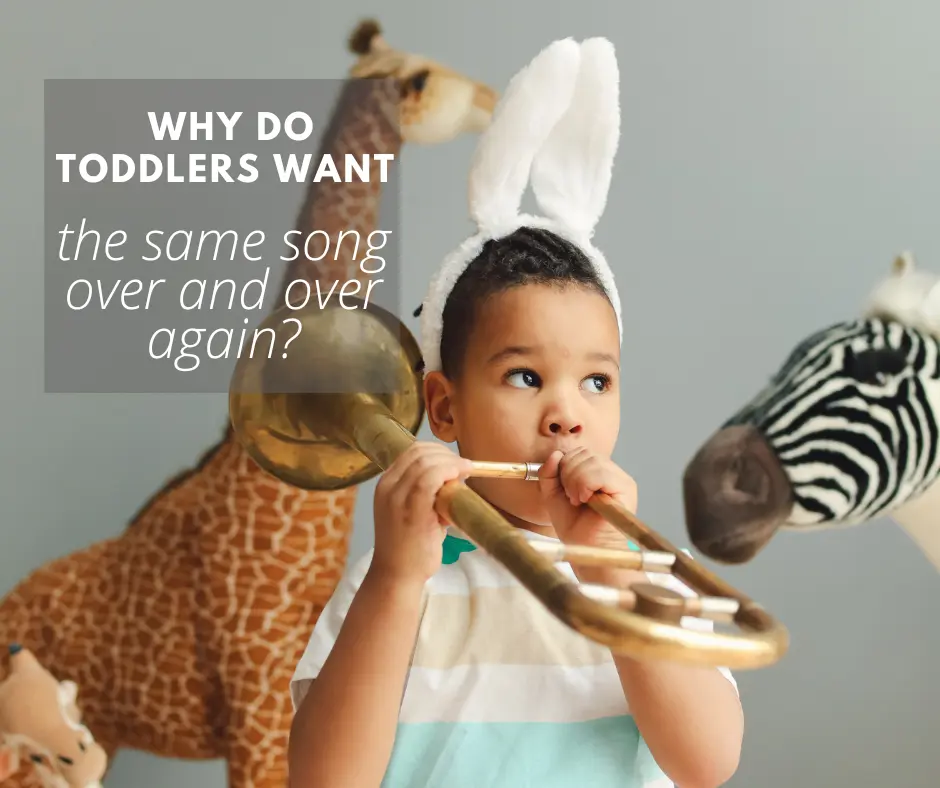
Why do toddlers want the same song over and over again?
Quick answer updated November 2026
Repetition is how young children learn music. Hearing and playing the same song again and again helps them predict what comes next, build memory and coordination, and feel confident enough to try something new. A simple routine at home: keep 3 favorite songs, add 1 new song slowly, and refresh old favorites instead of replacing them.
It’s also how My Music Workshop lessons are built: each short video teaches one small skill, kids practice it in a play-along with a band, and they can rewatch any lesson as many times as they like.
There’s a moment most parents recognize. Your child asks for the same song again. And again. And again. Maybe it’s the bedtime favorite. Maybe it’s the car song. Maybe it’s the one with the hand motions you could now perform in your sleep. Somewhere between the third and fifth repeat, you might pause and wonder:
Is this still teaching anything?
Here’s the reassuring truth:
It is.
Repetition isn’t a pause in learning.
It’s where learning lives.
While adults often associate progress with variety, young children grow differently. They build understanding through returning and revisiting. Through doing something familiar enough times that it becomes their own. For young children, repetition isn’t a sign that growth has stalled. It’s the very process through which confidence, coordination, and understanding take root!
Why Adults Crave Variety (But Children Don’t)
Adults enjoy novelty because our brains are fully developed. We like discovery and fresh input. Young children, however, are building neural pathways from scratch. When they repeat a song or activity, their brain is strengthening connections. The first time they hear something, they observe. The second time, they begin predicting. The third and fourth time, they participate with confidence. What feels repetitive to you feels safe and empowering to them.
And it doesn’t have to be boring. One of the best ways to make repetition fun is with call-and-response songs. For example, “Down by the Bay” is perfect for this. You sing a line, your child echoes it, or adds their own silly rhyming phrase. It’s playful, creative, and keeps them engaged while still giving your brain the security of a familiar song.
Other great call-and-response options include:
- “B-I-N-G-O” — fill in the letters with claps
- “Hey, Hey, Look at Me” — add actions for extra fun
- “Who Let the Dogs Out?” (chorus) — high-energy and silly
What Is Actually Happening During Repetition
When your child sings the same song again and again, here’s what’s quietly developing:
- Pitch matching
- Breath control
- Memory
- Language rhythm
- Anticipation
- Listening skills
- Confidence
The first time they hear “You Are My Sunshine,” they may just listen. By the fifth time, they fill in the last word of each line. By the tenth time, they will sing independently. Repetition gives children time to move from passive listener to active participant.
Repetition Builds Musical Skills Without Pressure
Young children do not need formal explanations about rhythm or tempo. They need repeated, playful experiences.
For example:
- When you sing “Old MacDonald” regularly, your child begins to anticipate the animal sounds and match pitch naturally.
- When you clap along to “If You’re Happy and You Know It”, they begin to internalize steady beat.
- When you move to “Shake It Off” or “Happy”, they begin to feel tempo in their bodies.
- When you play “Baby Shark” for the hundredth time (yes, that counts), they are strengthening memory and timing.
None of this requires instruction, it’s the repetition that does the teaching.
Repetition Builds Emotional Security
Music is not just skill building. It is emotional regulation. Think about what happens when a familiar bedtime song begins. Your child’s body softens. Their breathing slows. They know what comes next. Or imagine circle time. The moment “Head, Shoulders, Knees, and Toes” starts, children light up because they know the movements. There’s no uncertainty.
Familiar songs create:
- A sense of competence
- Reduced performance pressure
- Emotional comfort
- A feeling of belonging
When children know what comes next, they are more willing to participate fully. That confidence spills over into other areas of learning like language and literacy, motor skills and coordination, mathematics, and memory.
How Much Repetition Is Too Much?
This is the question many parents quietly wrestle with. If we keep singing the same songs, am I limiting my child?
Shouldn’t I be exposing them to more? It’s an important question because as adults, we tend to associate variety with enrichment. We assume that “more” equals “better.” But for young children, depth matters more than variety. Repetition becomes unhelpful only when your child is clearly disengaged or resistant. If they are still asking for the song, participating, predicting lyrics, or adding their own ideas, it is not too much. What feels repetitive to you may still feel empowering to them. Young children often need many repeated exposures before they fully internalize a skill. Through repetition, neural pathways related to rhythm, language, and memory strengthen and become more efficient. What looks simple on the outside is actually complex brain work happening underneath. Instead of asking, “Have we done this too much?”
A better question might be, “Is my child still engaged?” If the answer is yes, you are just where you need to be.
A Simple Way to Implement Repetition at Home
If you like structure, here’s a practical approach:
Choose 3 Core Songs
Keep these consistent for 3–4 weeks.
For example:
- “Old MacDonald”
- “If You’re Happy and You Know It”
- “Twinkle, Twinkle, Little Star”
Let your child:
- Fill in missing words
- Suggest verses
- Add movements
- Change volume (whisper, loud, silly voice)
The song stays the same. Their participation deepens.
Add 1 New Song Slowly
Every 2–3 weeks, introduce one new piece.
It could be:
- A movement song like “Shake It Off”
- A calming listening piece like “Gymnopédie No. 1”
- A playful call-and-response song like “Down by the Bay”
- A short instrumental march like “Radetzky March”
Keep the core songs steady while the new one gradually becomes familiar.
Refresh Without Replacing
If repetition starts to feel stale for you, adjust the experience instead of changing the material:
- March to the song
- Tap rhythm sticks or pots and wooden spoons
- Sing it faster or slower
- Turn it into a whisper game
- Let your child be the “leader”
You don’t need more content. You need more ways to experience the same content!
Why This Matters for Parents
Understanding repetition changes the emotional tone of music time. You no longer feel pressure to constantly introduce something new. You don’t need elaborate plans. You don’t need a rotating playlist. Good news! You can relax into what already works. Repetition reduces decision fatigue. It builds your confidence as the guide. And when you feel calm and capable, your child feels it too. Music becomes connection and not performance.
In the Simplest Terms
If your child is engaged, repetition is working.
If they are joyful, repetition is building confidence.
If they are predicting what comes next, repetition is strengthening their brain.
You do not need more songs, you just need time with the songs you already have. Repetition is not doing less. It is actually building more.
References
Gordon, E. (2007). Learning Sequences in Music.
Hannon, E. & Trainor, L. (2007). Music acquisition and enculturation research.
Rovee-Collier, C. (1999). The development of infant memory.
Trainor, L. & Corrigall, K. (2010). Music acquisition and effects of musical experience.
Ready to start lessons at home?
Step-by-step video lessons for kids 4 to 12 with Mr. Elias, with play-alongs and picture quizzes. Each lesson takes about 10 to 15 minutes. From $10 a month.