How to Teach Music When You Homeschool (Even If You’re Not Musical)
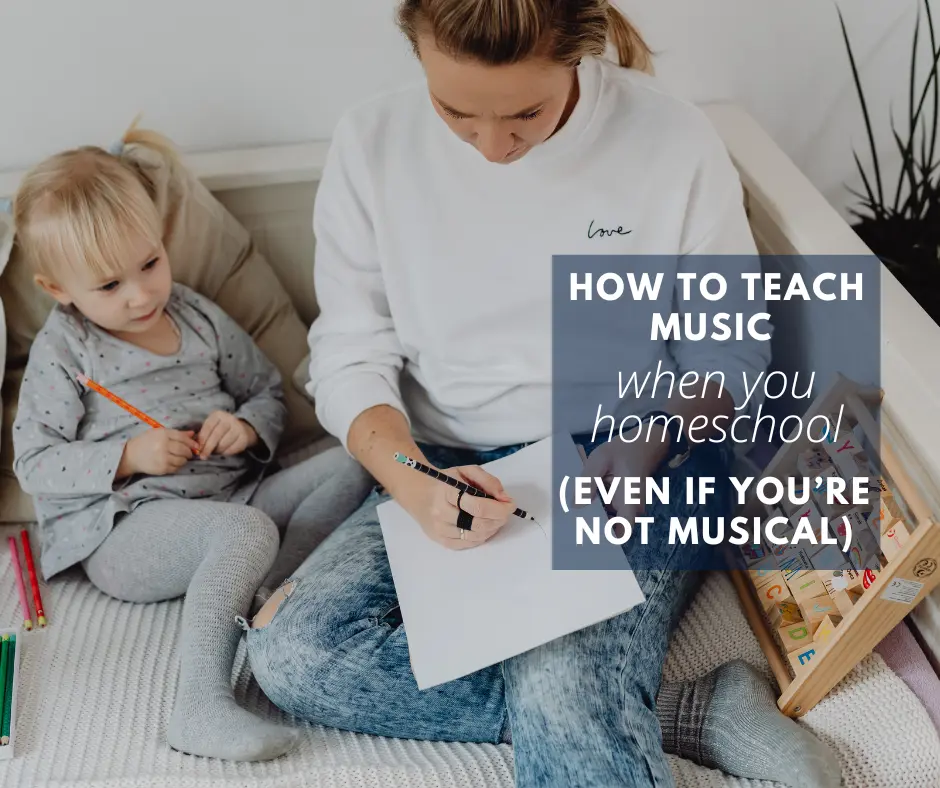
If you’re homeschooling, you’ve probably asked yourself at some point,
“Am I supposed to be teaching music?”
And right after that,
“But what if I’m not musical at all?”
Take a deep breath. You are not alone.
Music is one of the most intimidating subjects for homeschool parents. Many parents worry because they never took music lessons themselves, don’t read music, don’t play an instrument, or already feel stretched thin. When you’re juggling multiple subjects, adding music education can feel overwhelming.
Here’s the good news:
You do not need to be musical to teach music in your homeschool.
What you need is a simple, realistic approach to homeschool music education that fits into your day.
What Counts as Music Education in Homeschooling?
One of the biggest misconceptions about homeschool music education is that it has to look like formal lessons or instrument practice.
It doesn’t!
For young children, music education at home often looks like everyday experiences. Singing together, listening to different styles of music, and moving or dancing to music all count. These activities help children develop rhythm, listening skills, and musical awareness in a natural way.
Here are a few real-life examples of what homeschool music education can actually look like:
- Singing familiar songs together during morning time or while getting ready for the day
- Playing music in the background during art, free play, or quiet time
- Dancing or moving to music in the living room to reset energy between subjects
- Clapping or tapping along to a song while sitting at the table
- Listening to different genres of music and talking about how they sound or feel
- Repeating simple rhythm patterns using hands, feet, or household items (Fast claps / slow claps, jar with rice or beans)
- Singing songs with hand motions or simple movements (wheels on the bus, hokey pokey etc.)
If music is happening in your home, learning is happening.
For preschool and early elementary homeschoolers, experience matters more than theory. Exposure matters more than perfection. Joy matters more than technique. When music feels playful and pressure-free, children absorb far more than we realize.
“But I’m Not Musical” — Why You Can Still Teach Music at Home
This is the biggest mental roadblock for many homeschool parents.
You do not need to read music, play an instrument, or explain musical terms to your child in order to teach music at home. Music is not learned the same way math or reading is learned.
Children learn music the same way they learn language. They listen first. They experiment with sound. They repeat what they hear. They play. Over time, musical understanding develops naturally. Your role in homeschool music education is not to be the expert. Your role is to provide exposure.
The Simplest Way to Add Music to Your Homeschool Day
If teaching music feels overwhelming, start small.
Music does not need its own long lesson block. It can be woven into your homeschool routine. Singing a simple good morning song, playing music during clean-up, or adding a familiar song before lunch or bedtime are easy ways to include music without extra prep.
Music can also be used during breaks. Clapping rhythm patterns, marching around the room, or tapping beats on the table helps children release energy while strengthening musical skills.
Keep it short! Five minutes counts. Short, consistent experiences are far more effective than long, stressful lessons.
How Often Should Homeschoolers Do Music?
This is one of the most common questions parents ask about homeschool music education.
A realistic approach is:
- Two to three short music experiences per week (dance party, cleanup song, experimenting with musical instruments)
- Five to ten minutes at a time
- Daily listening to music counts (turn on classical music when kids are coloring/working/playing or get their wiggles out with movement songs like “head, shoulders, knees and toes” or “cha cha slide” for older kids)
Music does not need to happen every day to be effective. Skipping a week does not mean you failed. Flexibility is one of the greatest benefits of homeschooling, and music should support that flexibility.
Do You Need a Homeschool Music Curriculum?
Not always. Some homeschool families enjoy having a music curriculum for structure. Others feel overwhelmed by programs that are too rigid or academic. If you choose a homeschool music curriculum, look for one that is play-based, age-appropriate, flexible, and designed for parents without a music background.
Be cautious of programs that rely heavily on worksheets or focus on performance too early. Music education should build confidence, curiosity, and joy.
Are Online Music Lessons a Good Fit for Homeschool Families?
Many homeschool parents want guidance without adding another teaching role to their day.
Online music lessons can be a great option when they offer structure without stress, expert guidance without pressure, and lessons that work with a homeschool schedule. The best programs are designed for young learners and require little to no prep from parents.
At My Music Workshop, online music lessons are created specifically for busy homeschool families. Lessons focus on play-based learning, foundational music skills, and joyful participation, so parents do not need prior music experience to support their child. For many families, this means music education becomes a support, not another responsibility.
Why Music Education Matters in Homeschooling
Music education is about more than learning songs.
Music supports language development, memory, attention, pattern recognition, emotional expression, and confidence. Just as importantly, music creates connection, builds routine, and adds joy to your homeschool day.These benefits grow through simple, consistent musical experiences over time.
A Final Encouragement for Homeschool Parents
If you remember nothing else, remember this:
You are already doing enough.
Music in your homeschool routine does not need to be perfect, formal, or time consuming. Whether music happens through singing together at home, listening during quiet time, or exploring guided online lessons through My Music Workshop, your child is learning.
And you are doing a wonderful job.
Ready to start lessons at home?
Step-by-step video lessons for kids 4 to 12 with Mr. Elias, with play-alongs and picture quizzes. Each lesson takes about 10 to 15 minutes. From $10 a month.