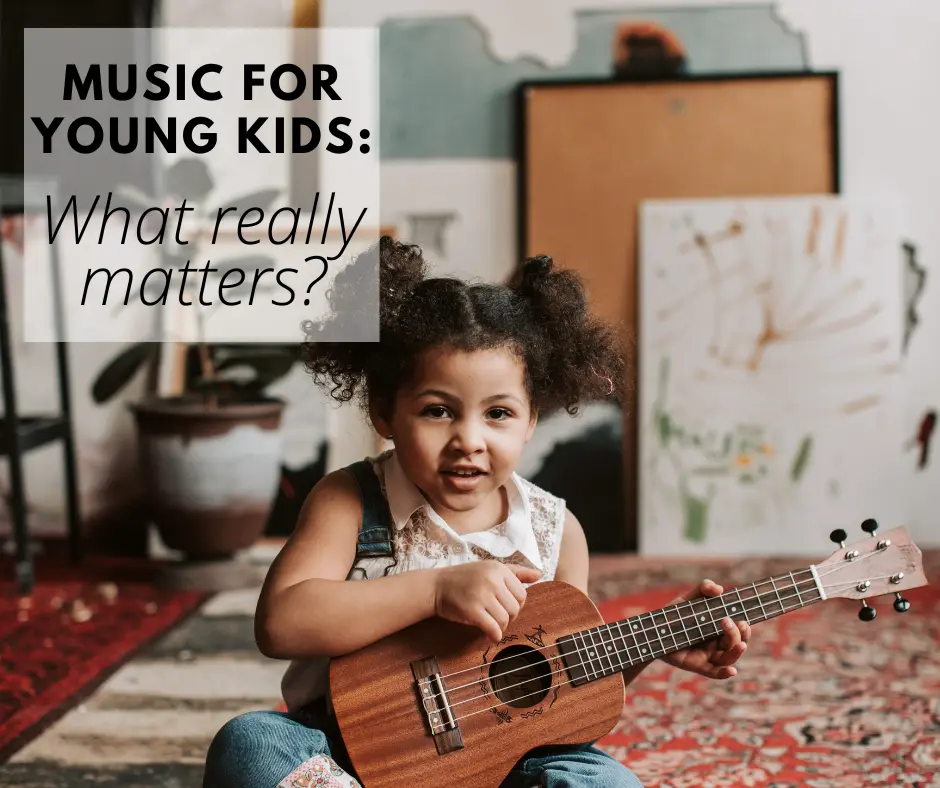
Music for Young Kids: What Really Matters?
If you are homeschooling a preschooler or simply trying to do right by your young child, you may have found yourself wondering things like:
“What should my child actually be learning in music?”
“Do they need lessons already?”
“Am I doing enough music stuff with them?”
Let me gently reassure you right away. At the preschool stage, music education does not need to look formal to be effective. In fact, the opposite is often true. For young children, music learning happens through experience. Through listening. Through singing. Through movement. Through playful rhythm. If music is happening in your home, learning is happening.
What Music Education for Preschoolers Is Not
Music education at this age is not about reading notes, perfect pitch, or sitting still for long periods of time. Preschoolers are still learning how their bodies work, how to listen, and how to express themselves. They do not need worksheets or performance pressure. They need exposure, repetition, and joy. So let’s talk about what actually matters!
1. Listening: Building Musical Ears Without Trying
Listening is one of the most powerful and overlooked parts of early music education. Simply hearing music regularly helps children develop musical awareness, memory, and sensitivity to sound. You do not need constant variety. In fact, repeating the same pieces over several days or weeks is ideal.
Classical or instrumental music that works beautifully for preschool aged kids:
- Mozart Piano Sonata in C Major K. 545
- Mozart Eine kleine Nachtmusik first movement
- Saint Saens Carnival of the Animals especially The Swan or Fossils
- Tchaikovsky The Nutcracker Suite March or Dance of the Sugar Plum Fairy
- Debussy Clair de Lune for calm moments
Try playing one piece during breakfast each morning or during quiet playtime. No explanation required. Let it wash over them and see how they respond!
2. Singing: Simple Songs Do the Heavy Lifting!
Singing is where so much learning happens. Melody, language development, pitch matching, and confidence all grow here. Folk songs and traditional children’s songs are especially powerful because of their repetition and simplicity. Remember, you do not have to be a great singer to sing with your child!
Some wonderful go to songs:
- Twinkle Twinkle Little Star
- Row Row Row Your Boat
- The Wheels on the Bus
- Skip to My Lou
- Oh Susanna
- This Little Light of Mine
Sing slowly. Sing imperfectly. Sing even if your child does not join in right away. Listening counts too.
3. Movement: Where Music Meets the Body
Preschoolers learn through movement. Music that invites marching, swaying, jumping, or freezing helps children internalize rhythm and musical contrast. And most importantly, it’s a lot of fun!
Songs that naturally invite movement:
- London Bridge
- The Ants Go Marching
- If You’re Happy and You Know It
- Trepak from The Nutcracker for fast energetic movement
Try a simple game; march fast and then march slowly. Freeze when the music stops! No instructions needed beyond modeling.
4. Rhythm: Keep It Simple
Rhythm does not require instruments or lessons. Hands, feet, and household items work perfectly.
Easy rhythm ideas:
- Clap the beat while singing “BINGO”
- Stomp stomp clap during “We Will Rock You” using only body percussion
- Tap spoons on the table to “When the Saints Go Marching In”
- Shake a container of rice softly, then loudly
You are not teaching technique. You are building coordination and awareness…and the best part is your spending quality time together.
5. Dynamics and Tempo
Contrast is one of the most important musical concepts for young children, and it can be explored easily.
Try these ideas:
- Sing “Twinkle Twinkle” once loudly and once in a whisper
- Play “In the Hall of the Mountain King” and notice how it starts soft and grows louder
- Move slowly to Clair de Lune and then quickly to Ronda all Turca from Mozart
This kind of playful exploration lays the foundation for musical understanding later on. Think of it like musical building blocks for your child’s brain.
How Much Music Is Enough?
Five to ten minutes at a time is more than enough. A few times a week is plenty. Built into daily life is ideal. Exposure matters more than perfection and experience matters more than explanation. Joy matters most!
When Extra Support Is Helpful
Many families love having a gentle structure or outside support to guide their music time. Programs designed specifically for young children can help parents feel confident without adding pressure.
At My Music Workshop, classes are play based, developmentally appropriate, and designed to meet children exactly where they are. Parents often express that they are relieved to learn that music education can feel this simple and joyful.
A Final Encouragement
If you are singing, listening, moving, and playing music together, you are doing enough. Music education for preschoolers is not about doing more. It is about noticing what is already working and leaning into it. Small moments truly matter. You’re doing great!
Ready to start lessons at home?
Step-by-step video lessons for kids 4 to 12 with Mr. Elias, with play-alongs and picture quizzes. Each lesson takes about 10 to 15 minutes. From $10 a month.